

When an equipment failure occurs or another emergency forces you to pull off the roadway, commercial motor vehicle (CMV) operators are required under Part 392.22 of the Federal Motor Carrier Safety Regulations (FMCSR) to follow specific rules to alert other motorists of your situation.
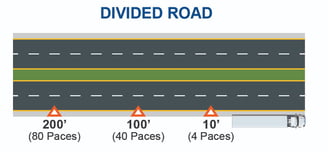
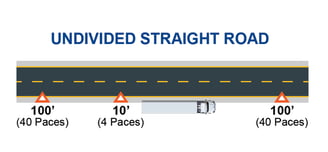
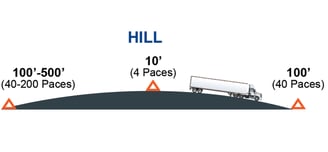
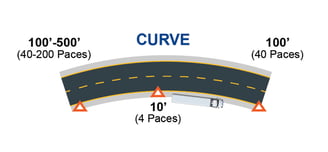
Below is a simple graphic and additional safety tips to keep in mind should you need to make an emergency stop. Read the information below and refer to the regulations to ensure you meet compliance requirements and protect yourself from harm.
Hazard Warning Signal Flashes
After stopping the truck, activate the hazard warning lights before placing the external warning devices (i.e., warning triangles, fusees or liquid-burning flares) around the truck. The hazard lights must remain on while picking up the warning devices and moving the vehicle. Hazard lights are not a substitute for placing warning devices around the truck.
Placement of Warning Devices
Except for necessary traffic stops, warning devices must be placed around the truck within 10 minutes of stopping. The diagrams below show the proper placement of warning devices. Refer to Part 392.22(b)(2) for a list of special rules regarding placement of warning devices.
Additional Safety Tips
-
If you are experiencing a medical emergency, call 9-1-1 immediately.
-
Wear a reflective vest when working outside the truck. If you do not have a reflective vest, carry the reflective triangles up near your chest when walking around the vehicle.
-
Use a flashlight in the dark to make yourself more conspicuous, and watch for slip, trip, and fall hazards.
-
Avoid walking near the roadway; walk along the side of the truck opposite the moving traffic lanes.
Note: These lists are not intended to be all-inclusive.
The information in this article is provided as a courtesy of Great West Casualty Company and is part of the Value-Driven® Company program. Value-Driven Company was created to help educate and inform insureds so they can make better decisions, build a culture that values safety, and manage risk more effectively. To see what additional resources Great West Casualty Company can provide for its insureds, please contact your safety representative, or click below to find an agent.

Insurance Contracts are Underwritten, Administered, and Issued by: Great West Casualty Company, Old Republic Life Insurance Company, and Old Republic Union Insurance Company.
One or more Old Republic companies may provide the products and/or services described. Information presented is for illustrative purposes only and does not constitute a contract or advice, including employment advice or advice to motor carriers. Please refer to the relevant insurance policy for actual terms. Products and services may not be available in all states and may be subject to change without notice. © 2026 Old Republic International Corporation. Old Republic® and the Old Republic Circle of Stars monogram are registered trademarks. All Rights Reserved.
